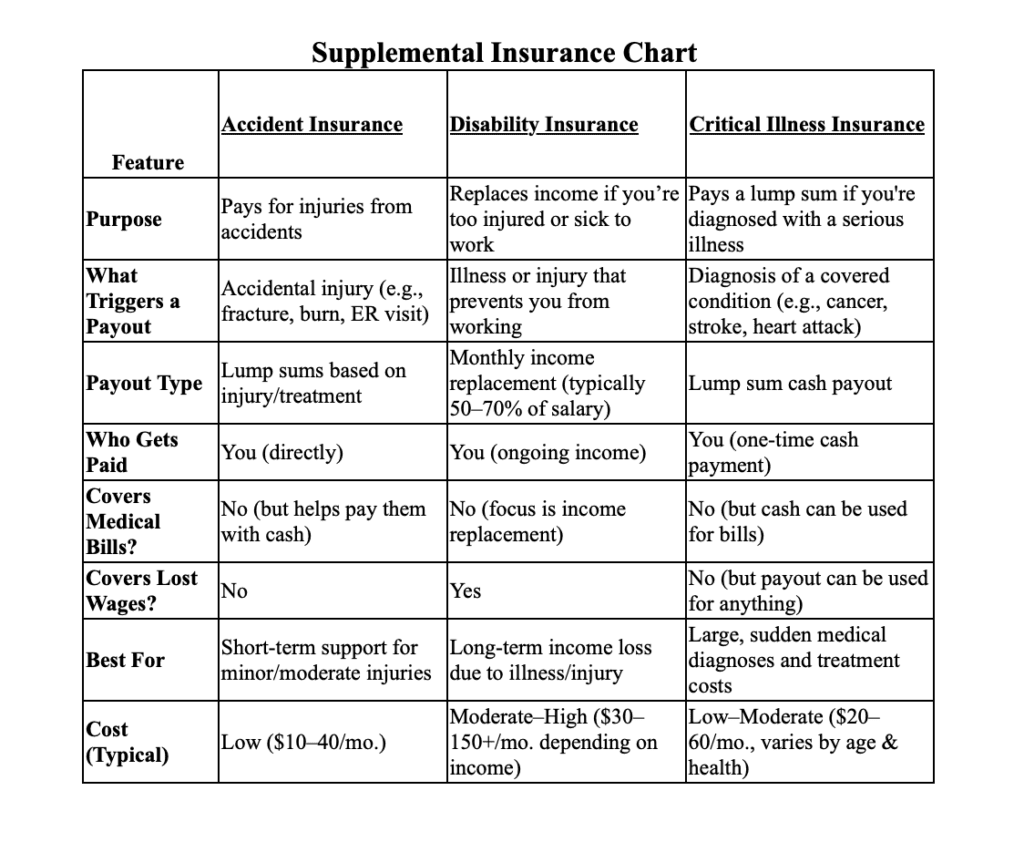
Accidents happen – it’s a fact of life. Whether you suffer a concussion falling off a ladder, break your leg skiing, or dislocate a shoulder tripping over your dog’s leash. Injuries can lead to costly expenses, loss of work time and additional difficulties. Supplemental Accident policies are just one way that you can create a layered safety net that helps you stay financially secure in the face of both everyday injuries and larger setbacks.
A supplemental accident policy offers financial protection and peace of mind by providing cash benefits when you are injured in an accident regardless of who is at fault.
Accident insurance is typically offered by your employer as a voluntary benefit.
-
Accident Insurance can help protect you financially in case of an accidental injury.
-
Traditional medical insurance won’t cover all your expenses such as lost time or travel expenses.
-
Accident insurance can help fill in those coverage gaps as you pay your out-of-pocket medical bills.
-
Accident coverage does NOT replace your medical insurance it is a supplement; offering additional coverage and financial assistance.
If your employer does not offer accident insurance or you are self-employed, accident policies can be purchased through an Insurance Broker or direct from an Insurance Carrier. There are several variations of accident policies that you can purchase, the most common being private individual accident policies through Brokers or Agents with Aflac, Mutual of Omaha, and Assurity.
Accident policies aren’t just for those who work in construction or who have back-breaking jobs Teachers, bankers, police officers, and IT Security Analysts should consider purchasing Accident policies; whether you are self-employed or work for the County or State, are the CEO of a large corporation or work an entry-level job at the local food store. If you are the main bread-winner, or the one who raises the children; and let us not forget to include the children.
Your safety net should ideally include:
-
health insurance,
-
disability insurance
-
emergency savings of 3-6 months of living expenses
-
life insurance
-
homeowners or renters’ insurance
-
accident policy
Optional but valuable extras if they are within your budget also include: critical illness, hospital indemnity and long-term care plans.
These components ideally work together to protect you from unexpected expenses, income loss, and financial emergencies.
This month I am going to tell you firsthand how an Accident Policy worked for my family.
Until I began working at Landmark Insurance, I was completely ignorant when it came to Supplemental Insurance plans. I worked in the School System where they would always announce that the “Aflac representative” was in the building, but hardly anyone ever made the effort to meet with them. I was 22 and I didn’t know any better but now that I am in my 30s, I now am a lot wiser.
Last fall, exactly one week before Thanksgiving, and two days before we were scheduled to hop in the car for a fun family vacation, my two-year-old son climbed up the back of the couch pretending he was in gymnastics class and rolled right off onto the floor. Being his bedtime, he was hysterical, holding his hand, inconsolable. All he could say was “my hand.”
Not sure what he hurt and with him being so emotionally overloaded he immediately fell asleep as soon as I cuddled him. We iced on his hand, gave him Motrin, dressed him in jammies, and spent a fretful night of sleeping.
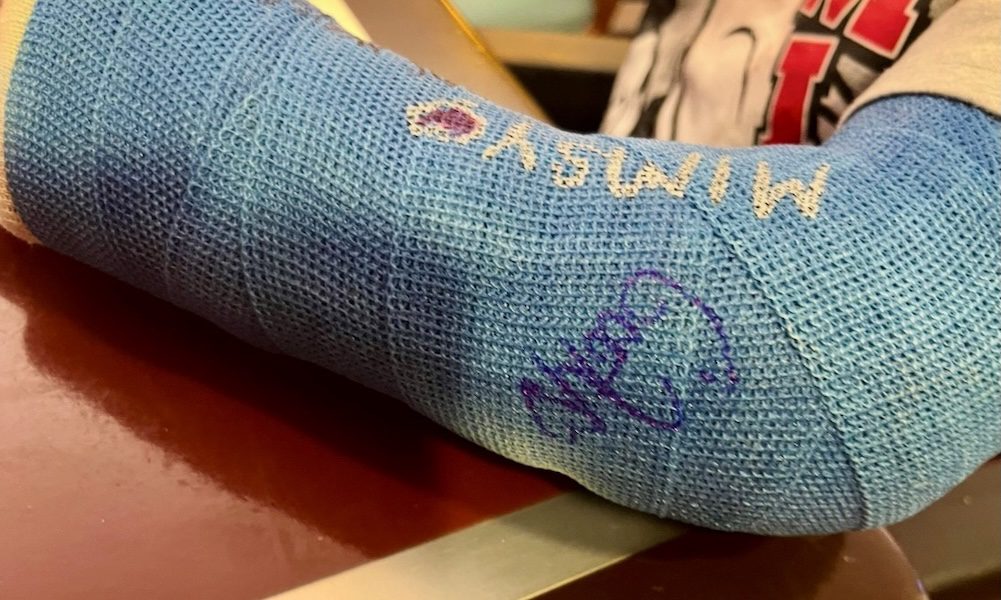
The next morning, my baby wouldn’t even move his arm. We took him to the Orthopedic. My little boy was put in a full cast up to his shoulder for the next five weeks, followed by a wrist brace through January 2025.
Not only did this “accident” carry from one healthcare plan year to the next, which meant meeting 2024s’ deductible and then starting over again in 2025, there was the cost of both my husband and I taking off of work to take our son to the doctor and staying home with him for the day – a day of lost wages, as well as a day of daycare that still had to be paid for.
-
The total cost of his Accident: $1615
-
Co-pay Visit: $30
-
X-rays $225
-
Cast Application $800
-
Co-pay Visit 2: $30
-
X-Rays: $75
-
Brace: $350
-
Co-pay Visit 3: $30
-
X-Ray: $75
In my mind I was panicking after that very first visit. One of our Employee Benefits Agents reminded me that we had an Accident policy when she heard what had happened, and that our son was covered under the family policy. All I needed to do was upload the appointment summary notes to the portal to begin the claim.
I had completely forgotten that we had an accident policy, and I had absolutely no idea how much it would pay for a broken bone. I was able to upload the information as we were in the car headed out for our family vacation. It helped me breathe a little easier knowing that we would get something to help, even if it was only a couple hundred dollars.
A few weeks later, the Insurance Company sent us a check that covered all of his expenses. To say that I was shocked was an understatement. At that time, he was still in the cast, I did not know that he was going to be put in the brace, or how much it would cost going into a new year and a new deductible.
With the check from the accident policy, my sons’ boo-boo arm became more of a funny family trip memory than a burden. That smelly cast still sits on top of his dresser because it’ been signed by some of his favorite people.
Accident insurance isn’t just for workers—it protects entire families, especially active kids. Sports, playground accidents, or even household mishaps can lead to costly ER visits. This coverage helps parents handle those surprises without financial stress.
Here is how Accident Policies fill critical gaps left by health insurance, disability coverage and your savings to create a secure safety net:
-
Covers Unexpected, Immediate Costs – An accident policy pays lump-sum cash benefits directly to you, so you’re not scrambling to cover bills, copays, or lost wages.
-
Protects Your Emergency Savings – Rather than draining your emergency fund, accident insurance can absorb the financial shock
-
Complements Health Insurance – Accident insurance pays you, not your provider, so you can use that money for anything—including rent, groceries, or child care.
-
Supports the Whole Family – Family members—especially kids—can be just as prone to accidents. Policies that cover dependents offer broad protection, especially for sports injuries and playground mishaps.
-
Helps Replace Short-Term Income – If an accident takes you (or a spouse) out of work temporarily, accident payouts can help bridge the income gap—especially for those without short-term disability insurance.
There are many ways to build your financial safety net or puzzle, a supplemental accident policy is just one piece that should be considered. In my case, it saved us a huge out of pocket fee around the Holidays, and it gave me peace of mind to enjoy my family trip without having to worry about what I was spending.
Accidents are going to happen, whether you have children or not. I’ve been known to fall walking up the stairs. The dog is constantly under my feet. Do you really trust every driver on the road? Accident policies are a supplement to other policies and pay out regardless. They are there if the need arises, to protect you from dipping into your emergency fund, your savings, or even your retirement. Live smart. Start putting your financial safety puzzle together today.